
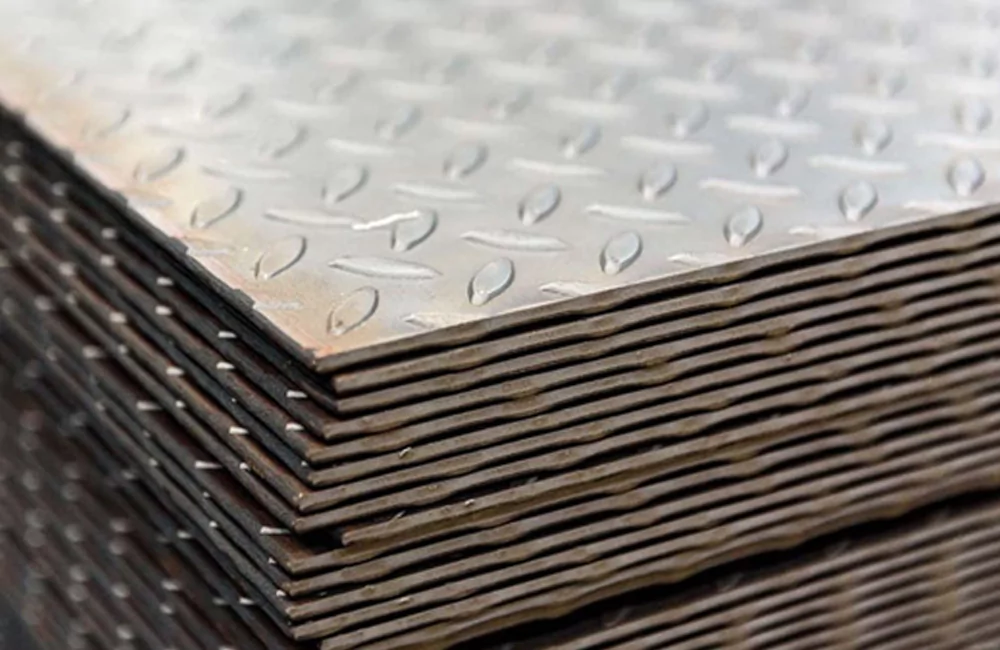
When someone calls us for a chequered plate, the first question we ask is — "what thickness, and is this for a ramp or a floor?" That's where most buying mistakes happen. Not in the product itself — in the spec.
Pick the wrong thickness for a vehicle ramp and the plate bends under load within months. Over-spec a pedestrian walkway and you've added unnecessary weight and cost to your structure. Both are avoidable — and at Magnus Steels, we'd rather catch it before the order than after the installation. Here's everything you need to get the spec right.
Most orders come in as "just chequered plate" — but some applications specify a pattern, and getting that wrong adds rework. Here's what's available and where each one belongs.
The most common pattern in India. Four raised ridges form a diamond shape across the face. Good all-around grip, easy to weld and fabricate, and the most widely stocked. This is what most yards mean when they say "chequered plate" without specifying further. Used in walkways, truck beds, and general industrial flooring.
Five parallel raised bars offset at 60°. Associated with Tata Steel's Durbar brand, which is IS 3502 certified. The five-bar pattern drains water more effectively than diamond patterns — which is why it's preferred for outdoor ramps, loading docks, and marine platforms. If your project spec says "Durbar," this is what's being called for.
Lighter raised pattern, lower profile. Less grip than diamond or five-bar, but easier to clean and better for environments where material buildup (dust, grain, chemical residue) would clog deeper patterns. Used in food processing facilities, grain storage floors, and areas that need frequent washing down.
Oval raised dots rather than ridges. Provides directionally neutral grip — effective in all directions equally. Used in stair treads, equipment platforms, and bus/truck flooring where feet or loads can approach from any angle. Less common in stock — usually ordered specifically for these applications.
This is the question that comes up almost every time a contractor calls. They know the area they need to cover, and they want to know what the plate will weigh — for transport, for the structural frame calculation, or for cost estimation.
The key thing to understand: chequered plate weight is calculated on the base thickness, not on the total thickness including the raised pattern. The pattern adds approximately 5–8% to the actual weight of the plate — most fabricators build that into their calculations. The table below shows base plate weight per square metre at standard mild steel density (7,850 kg/m³), with a practical estimate including pattern weight.
| Base Thickness | Base Weight (kg/m²) | With Pattern (approx.) | Typical Application |
|---|---|---|---|
| 2 mm | 15.7 | ~16.5 kg/m² | Light interior decorative flooring, wall cladding |
| 3 mm | 23.6 | ~25.8 kg/m² | Pedestrian walkways, light-duty steps, access panels |
| 4 mm | 31.4 | ~33.7 kg/m² | Stair treads, equipment platforms, workshop floors |
| 5 mm | 39.3 | ~41.7 kg/m² | Vehicle ramps, loading docks, industrial mezzanines |
| 6 mm | 47.1 | ~49.6 kg/m² | Heavy vehicle ramps, truck body floors, crane platforms |
| 8 mm | 62.8 | ~65.5 kg/m² | Heavy structural flooring, ship decks, mining platforms |
If you're calculating material cost from this table, remember that suppliers price by the kg. Take the area of your project in m², multiply by the pattern-inclusive weight from the third column, and that gives you the total weight you're ordering. Call us with that number and we'll quote you directly.
Same situation as every other steel product — the sizes on a website are not always sitting in the yard. Call before you send a vehicle. Here's what we keep in ready stock at Masakalipalayam across standard thicknesses:
| Size (feet) | Size (mm) | Thicknesses Available | Common Application |
|---|---|---|---|
| 8 × 4 ft | 2440 × 1220 mm | 3 mm, 4 mm, 5 mm, 6 mm | Walkways, platforms, most fabrication uses |
| 10 × 5 ft | 3050 × 1525 mm | 4 mm, 5 mm, 6 mm | Ramps, vehicle loading areas, long-span coverage |
| 6 × 3 ft | 1830 × 915 mm | 3 mm, 4 mm | Stair treads, small repair patches, lighter panels |
| Custom cut | As specified | 3 mm to 8 mm | Bulk orders — call with exact dimensions |
If you need a size that isn't here, tell us your dimensions before you lock in your purchase order. We'll confirm what's available as-is and what would need to be cut — along with the timeline and cost. No guesswork on the day of delivery.
Factory mezzanine floors, operator platforms around machinery, and maintenance walkways above ground level. The grip surface matters when workers are carrying parts or tools and the floor is subject to oil, water, or dust. 4mm to 5mm is the typical spec here — enough rigidity between frame supports without overloading the structure.
One of the highest-load applications for chequered plate. Two-wheelers, forklifts, and trucks rolling up a ramp concentrate load on a small area at the transition point. 5mm to 6mm base is the minimum for any vehicle ramp — and the five-bar (Durbar) pattern is preferred here because it channels water off the surface rather than pooling in the grooves.
Commercial vehicle body builders use chequered plate for truck floors, bus floors, and goods carrier beds. The raised pattern prevents cargo from sliding during transit. 4mm to 5mm is the standard for most truck bodies — heavier cargo vehicles and tipper lorries typically go up to 6mm. This is one of the largest volume uses for chequered plate across Tamil Nadu's transport industry.
External staircases on industrial buildings, access steps on tanks and vessels, and maintenance ladders use chequered plate treads. The anti-slip surface is the whole point — bare steel stairs become dangerous the moment there's moisture. 3mm to 4mm is usually sufficient for stairs, but the front edge (nosing) of each tread takes significant impact and is often reinforced separately.
Cattle shed flooring, tractor ramp approaches, and grain storage floor sections. In rural Tamil Nadu, chequered plate is increasingly used where concrete would crack under livestock movement or heavy equipment. It's faster to install, can be moved or replaced section by section, and doesn't require curing time. 4mm is the typical starting point for these applications.
Scaffold walkways, temporary covers over trenches, and site access bridges between levels. Chequered plate is reused across multiple projects — bought once, moved between sites. The raised pattern matters here because construction sites are permanently muddy and dusty. 4mm is the standard for temporary site use — light enough to move, strong enough across a 600mm frame spacing.
We've seen this happen at vehicle ramps more than anywhere else. A contractor specs 3mm chequered plate because it's cheaper and "it's just a ramp." A fully loaded delivery vehicle — 8 to 10 tonnes — rolls up it regularly. Within three months, the plate has deflected, the welds have cracked at the frame connections, and there are visible dips across the surface where the load concentrated.
The fix costs more than doubling the original material spec would have. New plates, cutting out the old welds, re-laying the surface — plus site downtime if the ramp is the only vehicle entry point.
The reverse problem — over-specifying — is less damaging but still wasteful. A pedestrian walkway between two building sections at 6mm instead of 3mm adds unnecessary weight to the structure, may require additional frame support, and costs nearly double the material. Neither direction is free.
The quick rule: match the thickness to the load, not to the price. If you're not sure which thickness fits your application, describe the load and the span to us before you order. It's a two-minute call that makes the decision straightforward.
If you're comparing quotes from multiple suppliers and getting very different numbers, here's what's actually moving the price:
We stock MS chequered plates at our yard in Masakalipalayam, Coimbatore — diamond and five-bar patterns, 3mm through 8mm, standard sizes and custom cut. One call to confirm availability, price, and delivery — no back-and-forth across multiple suppliers.
| Location | Delivery Time | Notes |
|---|---|---|
| Coimbatore city & outskirts | Same day | Order before noon for same-day dispatch |
| Tirupur | Next day | Regular runs — confirm slot when ordering |
| Erode | Next day | Bulk orders prioritised |
| Salem | 24–48 hours | Coordinate with our team for scheduling |
| Pollachi | Same day / Next day | Frequent runs — call to confirm |
Before you book transport or send your vehicle, call us at +91 80155 27611 to confirm the thickness and size is in stock. We'll tell you exactly what's available, give you today's price, and confirm the delivery slot — all in one call.
MS chequered plates look simple — they're anti-slip steel sheets. But the difference between 3mm and 6mm, or between a diamond pattern and a five-bar Durbar, is the difference between a platform that holds up for years and one that needs replacing within months.
At Magnus Steels, we stock the full range — patterns, thicknesses, and standard sizes — from our yard in Coimbatore. We deliver same-day within the city and next-day to Tirupur, Erode, and surrounding areas. If you've been buying from a supplier who can't confirm the spec or shifts the price between the call and the truck — give us one conversation. We'll show you what a straightforward steel supply relationship looks like. Call +91 80155 27611.